
The best attraction queues do more than give us somewhere to wait. They begin the experience before we ever board the ride.
When we talk about attraction queues, the conversation usually begins with one question: How long was the wait?
That makes sense. No one goes to a theme park because they want to stand in line. We put up with it, often surrounded by people we don’t know, because the attraction is waiting for us at the other end.
At least, that is how I thought about queues when I was growing up.
Opryland USA was my home park, and I don’t remember most of its queues being a significant part of the attractions. They served their purpose. You entered the line, moved through the switchbacks, and waited for your turn to ride.
There were exceptions. The queue for the Screamin’ Delta Demon did a decent job of creating the feeling of a Louisiana bayou. By the standards of the late 1980s and early 1990s, it had real atmosphere and helped the coaster fit into Opryland’s New Orleans area. The coaster also had a unique sound—something like rolling thunder—that added to the mood of the attraction.
Chaos, Opryland’s indoor roller coaster, also made a real effort to theme its queue. As a kid, I didn’t understand why ticking clocks covered the walls or why an annoying voice kept repeating, “Please move quickly through the station. Your time is running out.”
But the first queue I remember feeling like a major part of the attraction was Space Mountain at Walt Disney World.
The line was still long. The theming didn’t make the wait disappear. But once I entered the building, it felt like I had begun moving toward something. The music, the lighting, and the scenes around each corner created a sense that I was getting closer to space. Along the long hallway, you could look through windows and see planets and stars appearing to float past.
I had not boarded the ride yet, but the experience had already started.
That was the first time I understood that a queue could be more than a place to hold people. It could prepare you for the attraction waiting at the end.
Leaving the park behind
Every attraction has to move guests from one world into another.
One moment, you are standing in a theme park surrounded by strollers, snack carts, conversations, and people checking wait times on their phones. A few minutes later, you may be exploring an abandoned temple, entering a haunted house, traveling into space, or accepting a secret mission.
That transition cannot always happen the moment you board the ride. Guests need time to leave the outside world behind.
A well-designed queue helps make that happen gradually.
The architecture may begin to change. The background music becomes more noticeable. Signs, props, and small details start revealing where you are and what may be about to happen. Sometimes you are given part of the story directly. Other times, the environment allows you to put it together for yourself.
Pirates of the Caribbean at the Magic Kingdom is a good example.
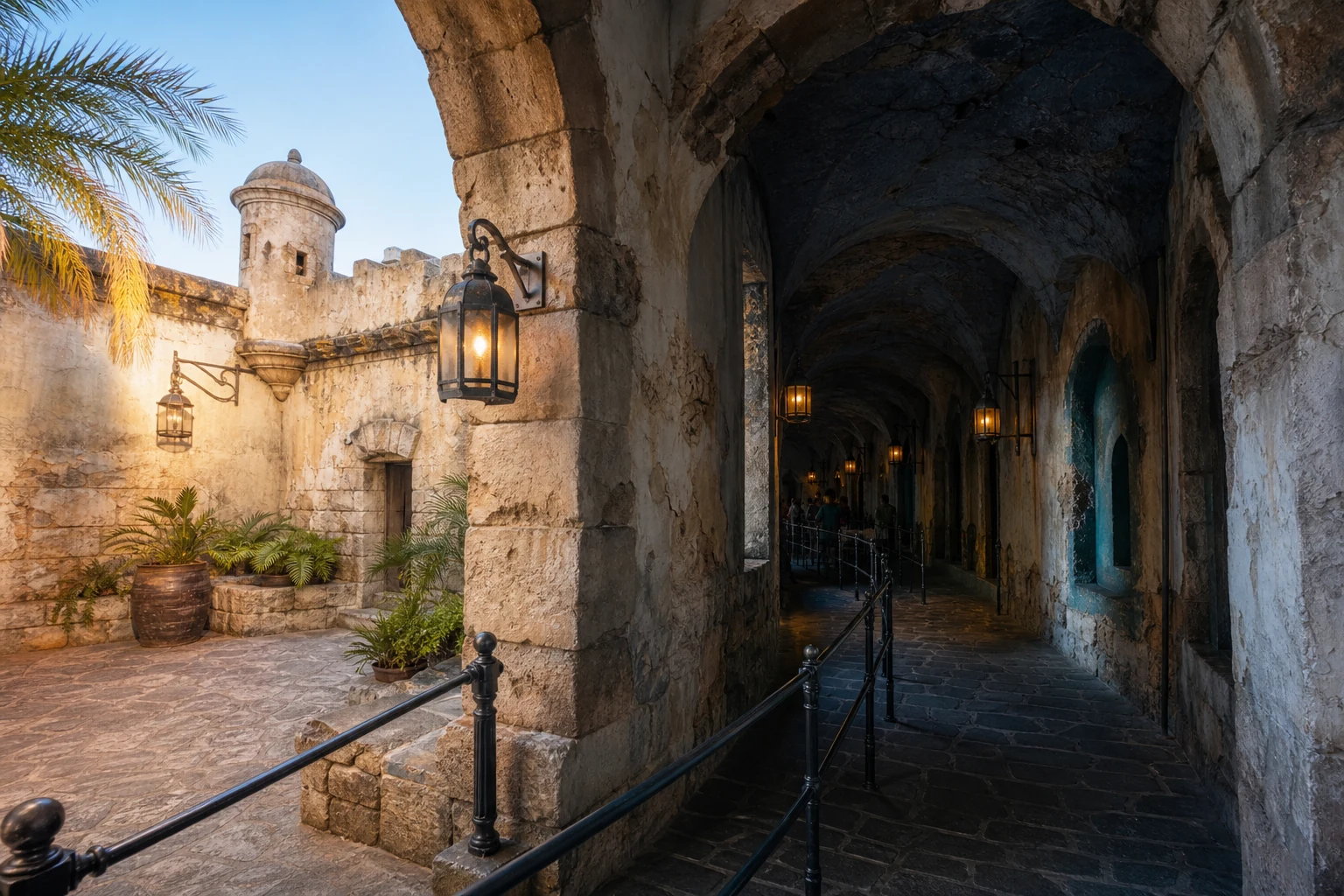
The queue begins in an area that feels somewhat like an outdoor courtyard. Once you enter the building, the atmosphere changes. The passageways become darker, cooler, and more enclosed. It begins to feel less like a theme-park building and more like a secure Spanish fort—or even a dungeon.
There isn’t a long explanation telling you exactly what to think. The building does the work.
By the time you reach the boats, you have already left Adventureland behind. You feel as though you have entered an old Caribbean fortress where pirates might actually be nearby.
That is why I think of the queue as the first act of an attraction.
In the first act of a movie or play, we meet the characters, enter the world, and begin to understand the situation. We may not know exactly where the story is going, but we know that something has started.
A good queue can accomplish the same thing.
Space Mountain did that for me without needing an elaborate storyline. The music and surroundings were enough to create anticipation. I felt as though I were moving deeper into a spaceport and getting closer to launch.
By the time I reached the loading platform, I was ready to go somewhere.
When waiting becomes part of the story
The attraction that I think does this best today is Star Wars: Rise of the Resistance at Disney’s Hollywood Studios.
There are several points during the experience when guests have to wait, gather, or move from one area to another. Any of those moments could have felt like another holding area. Instead, they are presented as parts of the mission.
You begin as a recruit for the Resistance. You receive your assignment and board a transport, only to be captured by the First Order and taken aboard a Star Destroyer. Each transition changes your location and your role in the story.
The story does not wait for you to reach the main ride vehicle. It has already begun.
Even the Cast Members become part of it.
The first time I experienced Rise of the Resistance, I didn’t realize how completely the Cast Members working for the First Order would stay in character. While we were waiting, I casually asked one of the First Order officers how long he had until his next break.
He quickly told me that it was none of my concern.
Then he raised his voice and ordered me to stand on the red line beneath my feet.
For a moment, my reaction was, “Are you kidding me?”
Then I realized what was happening. He wasn’t simply a Cast Member managing a line. Within the story, he was a First Order officer dealing with a captured Resistance recruit—and I was not following his instructions.
I got a big smile on my face while my teenage daughter stood there laughing at me.
That brief interaction became one of the things I remember most about my first time experiencing the attraction. It also showed me that theming doesn’t only come from architecture, props, music, or technology. Sometimes it comes from another person who understands the role they play in the story.
That is what makes Rise of the Resistance so effective. At some point, it becomes difficult to say exactly where the queue ends and the attraction begins.
You are still being moved into groups. You are still spending time in spaces designed partly to control the flow of guests. Operationally, some of these moments are doing the same job as a traditional queue.
They do not feel that way.
Instead of simply being asked to wait in another room, you are being briefed, transported, captured, and detained. The attraction gives the wait a reason to exist within the story.
You may understand that the experience is carefully moving groups of people toward the next part of the attraction. But for a few minutes, it is possible to stop thinking about the operation behind it and accept the role you have been given.
You are no longer standing in line. You are trying to escape from the First Order.
A queue doesn’t have to be elaborate
Rise of the Resistance is an enormous attraction. Most parks—and most attractions—could never devote that much space, technology, or money to a queue.
They don’t have to.
A queue does not need multiple preshows, large sets, or interactive technology to be successful. Space Mountain taught me that years ago. Pirates of the Caribbean creates its transition mostly through architecture and atmosphere. Even the Screamin’ Delta Demon found ways to give its queue a sense of place.
Sometimes music, lighting, and a carefully controlled view are enough to change the way a wait feels.
What matters is whether the queue has a purpose beyond holding people.
Does it create anticipation? Does it establish the mood? Does it reveal something about the place we are entering? Does it make us curious about what might be around the next corner?
Even a small attraction can do those things.
A sound heard in the distance can suggest something we have not seen yet. A window can offer a brief glimpse of the ride without showing everything. A collection of props can tell us who once occupied a room or why we have been asked to enter it.
These details do not have to explain the entire story. In fact, they may work better when they don’t.
Sometimes the queue only needs to give our imagination somewhere to begin.
The story still has to work as a line
Of course, a beautifully themed queue is still a queue.
Guests need to understand where to go. The line needs to move people safely and efficiently. It should provide reasonable comfort and accessibility. No amount of theming can make an extremely long or poorly managed wait enjoyable.
There is also a point where adding more things to look at can become distracting. Interactive elements may entertain guests, but they can also slow the line or cause people to miss details because they are focused on a screen.
The story and the operation have to work together.
That may be one of the most difficult parts of designing an attraction queue. It must perform a practical job while trying not to feel purely practical.
When it works, we stop noticing that we are being organized, divided into groups, and prepared for loading. We simply feel that we are moving forward.
The attraction has already begun
I still do not enjoy waiting in a long line. I don’t think any amount of theming will make me look forward to a two-hour wait.
But I do appreciate a queue that respects the time guests spend inside it.
The best queues give that time meaning. They create anticipation and help us shift from the real world into the attraction’s world. By the time we reach the loading platform, we are not beginning the experience from a standstill. The music, atmosphere, and story have already done some of the work.
Space Mountain was the first queue that made me recognize that possibility. Pirates of the Caribbean showed me how effectively architecture alone could create that transition. Rise of the Resistance is the attraction that, for me, carries the idea the furthest by making its holding areas—and even its Cast Members—part of the story.
The queue may be where we wait for the ride.
But when it is designed well, it is also where the attraction begins.
What attraction first made you feel that the experience had started before you boarded the ride?
Leave a Reply