
Some attractions stay with us for reasons that have very little to do with how advanced, expensive, or impressive they were.
Theme-park fans enjoy debating which attractions are the best. I know I do.
We compare the storytelling, the ride system, the sets, the music, and just about every other detail. We make rankings and defend our favorites. When a new attraction opens, it doesn’t take long before someone starts comparing it with whatever came before it.
But the attractions I miss the most would not necessarily appear on anyone’s list of the greatest attractions ever built.
My home park growing up was Opryland USA. When the park closed, Nashville lost more than a collection of rides. For many of us who grew up going there, we lost a place that held a big part of our childhood.
One of the attractions I remember most clearly is the Rock n’ Roller Coaster. It was my first real roller coaster.
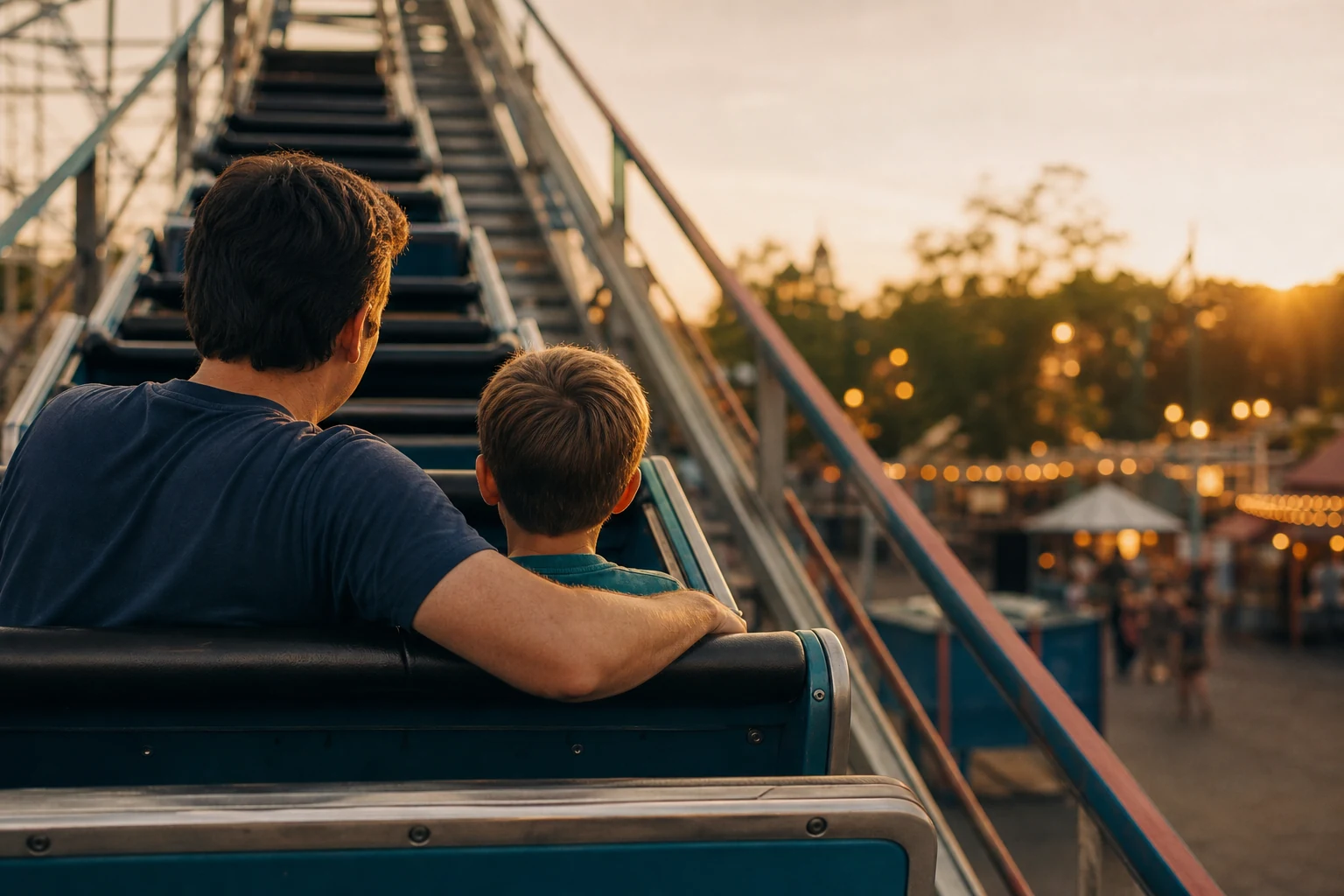
I remember riding it with my dad sitting next to me. Top Gun had recently come out, and before we went down the giant spiral hill at the end, he told me to pick one thing and keep my eyes focused on it. He said that was what fighter pilots did when they were training.
I have no idea whether that was actually true. At that age, I didn’t question it. My dad said it, so I believed him.
I tried to follow his advice as we went around the spiral. I’m not sure I was very successful, but I remember trying. More than anything, I remember that he was sitting there beside me.
By today’s standards, the Rock n’ Roller Coaster probably wouldn’t seem especially impressive. It wasn’t particularly tall or fast. It didn’t have an elaborate story, detailed sets, or cutting-edge technology. There are countless coasters today that are bigger, faster, and smoother.
But I would love to ride it with my dad again. I think we would spend most of the ride comparing what we remembered with what was actually there—and I would definitely ask him if he still stands by that fighter-pilot advice.
That is the strange thing about the attractions we miss. We are not always missing only the ride. Sometimes we miss a particular experience we shared with someone who is still very much part of our lives. The relationship continues, but the place that holds that specific memory is gone.
Attractions become part of our lives
We often talk about attractions as though they exist on their own. We judge how well they were designed or whether they still hold up against newer experiences.
But that is not how we actually remember them.
We remember being tall enough to ride for the first time. We remember the attraction that frightened us as a kid but eventually became a favorite. We remember parents, grandparents, siblings, and friends sitting beside us. We remember riding something one last time without realizing it would be the last time.
Once those memories become attached to an attraction, it is almost impossible to separate them.
That is especially true of a home park. A home park is different from a place you visit once on vacation. You return year after year. The attractions are waiting for you, mostly unchanged, while your own life keeps moving.
As a child, you may need someone to convince you to ride. A few years later, you are the one trying to convince someone else. Eventually, you bring your own family and introduce them to the places that meant something to you. At least, you hope you will have that chance.
When Opryland closed, many of us lost that opportunity. We couldn’t go back and see whether the park looked the way we remembered it. We couldn’t take another ride simply for old times’ sake. The place where those memories happened was suddenly gone.
Maybe that is one reason the ordinary attractions can become just as important as the headliners. They were part of the routine.
You knew where they were. You knew what was coming around every turn. You knew the sounds in the loading area and the moment when the lap bar clicked into place. None of it was surprising anymore, but that didn’t make it less enjoyable. Familiarity was part of the appeal.
Not everything needs to be groundbreaking
There is a tendency among attraction fans, and probably within the industry itself, to believe that every new experience must be bigger, more immersive, and more technologically advanced than the one before it.
Progress matters. I want to see attraction designers experiment with new ideas. I want parks to build experiences that would have been impossible a generation ago.
But an attraction does not need to change the industry to change someone’s life.
A simple ride can be the place where a child discovers that roller coasters are fun. A small theater attraction can become the family’s traditional afternoon break. An attraction that longtime fans consider outdated may be completely new to the person experiencing it for the first time.
Sometimes the imperfections even become part of what we love.
We remember the effect that didn’t always work, the unexpectedly rough turn, or the piece of scenery that looked a little less convincing every year. We noticed those things. We may have joked about them. But they gave the attraction a personality that was difficult to duplicate.
None of this means that parks should preserve every attraction forever. Parks have to change. Buildings age, audiences move on, and new ideas need somewhere to go. Still, I think something gets lost when the only question we ask is whether the replacement is technically better.
It probably is better in many ways. It may be smoother, more reliable, more detailed, and more popular. What it cannot have, at least not yet, is the history people built with what came before it. That takes time.
What we are really missing
Nostalgia can make an old attraction seem better than it actually was. I’m sure my memories of Opryland are shaped by the fact that I experienced the park as a kid. If I could walk through it today, I would probably notice things I never noticed then.
I don’t need to argue that every attraction I loved was an overlooked masterpiece. That isn’t why it mattered.
The Rock n’ Roller Coaster mattered because it was my first real coaster. It mattered because my dad was beside me. It mattered because, for a few moments, I got to imagine that I was doing what the fighter pilots in Top Gun did. That combination of ride, person, and moment can never be rebuilt somewhere else.
Maybe that is why the closure of an attraction can hit us harder than we expect. We know that our memories still exist, but we can no longer return to the place that helped create them.
The attractions we miss were not always the fastest, most advanced, or best designed. Sometimes they were simply there at the right time, with the right person sitting next to us. And that was enough.
What attraction do you miss—not because it was the best, but because of the memory attached to it?
Leave a Reply